Restoring Connecticut’s Missing Middle Housing: Is Our Past the Key to Our Future?
February 2026
Isaac Theodore Reicin
Email: Theodore.reicin@uvm.edu
Phone: (802) 448-0043
Undergraduate Student Researcher: University of Vermont, Burlington, VT
Executive Summary
Connecticut faces a serious housing shortage, driven in large part by decades of zoning laws that have banned the "middle housing" types — duplexes, triplexes, townhomes, and small multi-unit buildings — that once made the state's neighborhoods both vibrant and affordable. The result is a market where working families, seniors, and most noticeably young people, are priced out or forced to leave.
The solution is straightforward: Put quotas on middle housing zoning. The recent passage of Housing Bill 8002 creates a direct opening to do so. By empowering existing homeowners to add housing on their properties like the state did in the ADU laws, and working with towns to reduce the zoning barriers that block modest multi-unit construction, Connecticut can expand its housing supply quickly, affordably, and with broad public support.
This brief recommends that the legislature use HB 8002 as a precedent to set middle housing quotas across our largest cities and towns. Doing so is the single most effective near-term step Connecticut can take to close its housing gap.
The Problem: Connecticut Eliminated the Housing Types it Now Desperately Needs
Connecticut’s famed New England charm was built on small‑scale multi‑unit housing woven into single‑family neighborhoods. Rowhouses, duplexes, fourplexes, and courtyard apartments were once key parts of our housing stock. Modern zoning has made these forms effectively illegal across most municipalities, contributing to rising housing scarcity, increasing sprawl, and worsening affordability. For example, in the city of Stamford over half of the city zoning is locked for single family residences even in high density equipped areas, effectively blocking all increase in supply leading to a net housing shortage.
Evidence From Elsewhere: Edmonton’s Successful Zoning Reform
In 2023, Edmonton, Alberta, a Canadian city of 1.6 Million, rewrote its zoning code to legalize small multiplexes and rowhouses across the city. Many of the facades of these new buildings resemble those of the existing single-family homes, blending seamlessly into their neighborhoods and communities. Within two years, the city approved tens of thousands of new units, with 30% located within a 15‑minute walk of transit. The policy has been touted as one of the greatest successes in housing legislation of the last decade; aiding in the recent 15% population boom since 2021 that will add millions in economic stimulus to the city.
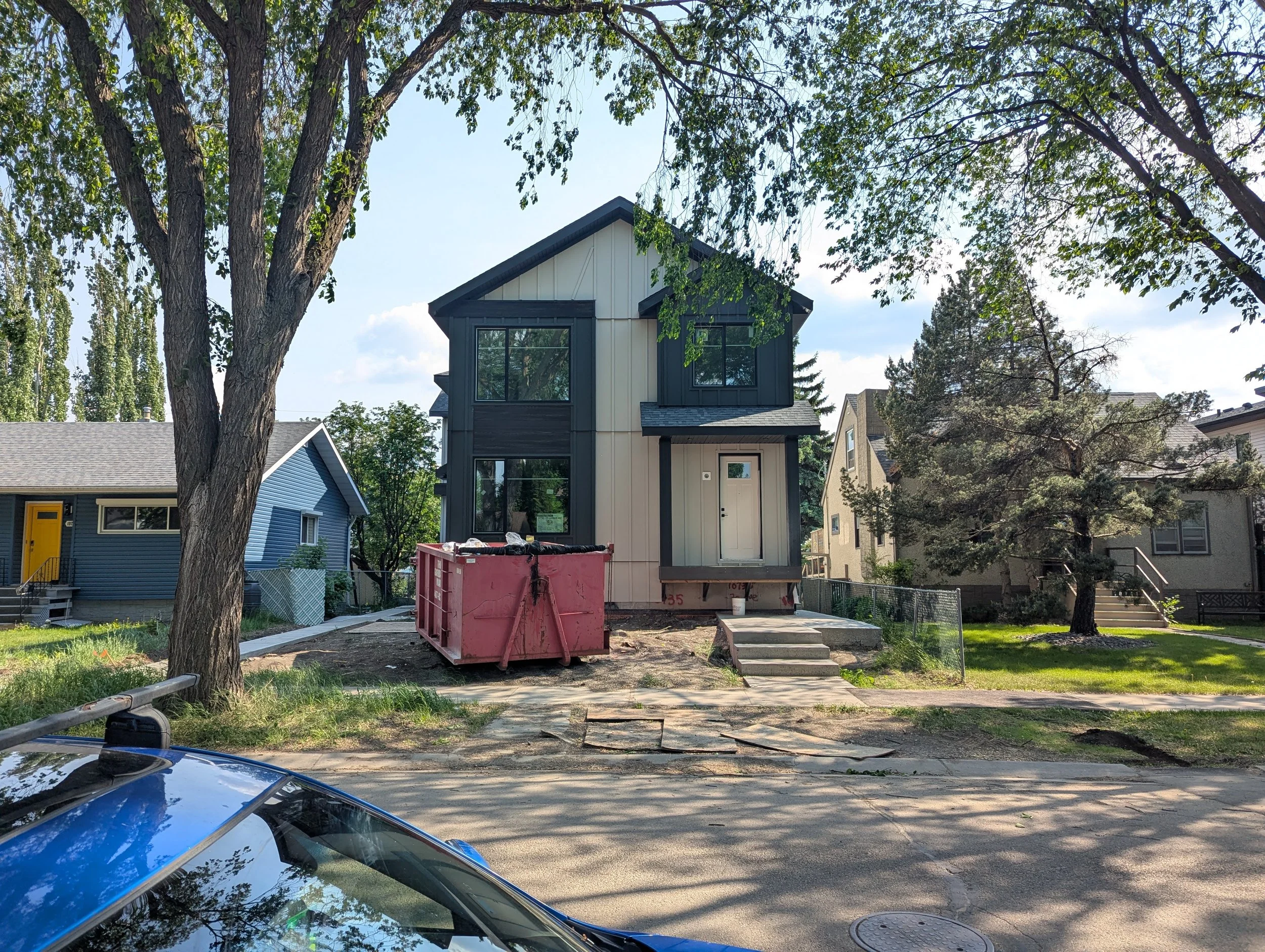
Middle housing in a modern look
Figure 1 An Eight-plex unit under construction in an Edmonton neighborhood (Credit: Jacob Dawang)
Policy Solution: Legalize, Incentivize, and Traditionalize. The Connecticut Middle Housing Approach
1. Restore pre‑1940s housing forms through statewide zoning authorization. Working hand in hand with existing cities and towns to bring successful reforms. This can be done by making an RS zone-esque designation for cities and towns like what was deployed in Edmonton.
2. Pair middle housing legalization with transit‑oriented development; making existing communities more accessible and affordable as well as creating new communities across the state.
3. Create homeowner‑friendly incentives to ensure existing property owners are partners who benefit from zoning changes like those in our ADU laws. These incentives include
• Shielding tax shocks from existing homeowners
• Empowering homeowners to take on small-scale development themselves
• Going through with neighborhood improvement projects
• Providing parking guarantees through limiting on-street parking and providing dedicated parking zones
• Reinvesting a portion of housing fees locally
4. Use regional data to target zoning reform. Identifying key neighborhoods and cities with the highest potential for growth.
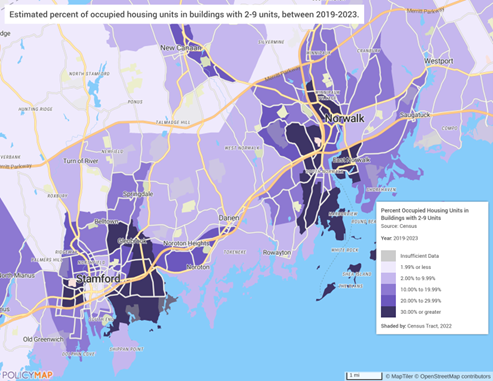
Figure 2 A middle housing density map of Stamford/Norwalk metro area
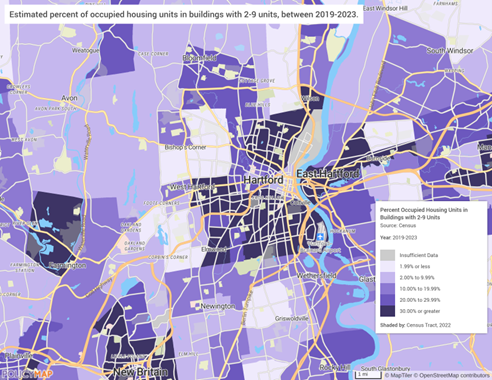
Figure 3 A middle housing density map of the Hartford metro area
Diagram Analysis
Our statewide development maps shown above in POLICYMAP display that outside of urban centers Connecticut neighborhoods lack substantial density which provides inadequate resources for development. To provide incentives for growth a reduction of government regulations could make building easier for existing homeowners and builders. In the maps, the outskirts of urban centers should be moving from the lighter colors to the darker colors, signifying over 20% of housing is registered “middle housing” to provide substantial growth headroom for the most effective economic development. This creates a gradient of density instead of abrupt single-family zoning in urban cores.
Expected Benefits
The National Bureau of Economic Resources acknowledges that density leads to increased access to amenities and significant productivity gains. They estimated an 8% gain in output from easing restrictions in only a few cities. If this same result was to be applied to our state economic size, this would extrapolate out to a $24 Billion growth in the Connecticut economy, bringing in over $1.5 Billion in state public revenues at current tax rates which could be used to fund transportation and social services. This could create a bowling ball effect within the state economy allowing for continued investments in transportation, leading incentives to densify further. The NBER study also concludes that market forces and natural political influences do not lead to optimal density, therefore decreasing economic output in urban centers without forced governmental deregulation to prevent a misallocation of population.
Risks of Implementation
While restoring traditional housing may have substantial long-term benefits there are several risks that could hamper the policy’s effectiveness. Connecticut’s long history of home-rule zoning can create uneven adoption or evenoutright noncompliancelike we saw with 8-30g statues. Local governments could comply slowly or adopt separate interpretations that thwart the objective of the policy. This resistance could weaken the impact and prolong housing stock shortfalls. Additionally, heavy political pushbacks would be imminent if framed in a hostile manner. Homeowners’ associations often state the “character of neighborhoods” to be sacred. In the 2026 Legislative Session SB00151 had racked up 188 testimonies in opposition from residents in Connecticut, showing just how strong neighborhood alliances can be.
Market related risks also present a challenge. Upzoning can raise land values in the short term as single family homes become worth more due to shortened supply and constant demand. The market dynamics create a profitability cap within the market, inducing a shift to only the most profitable markets which could leave a gap in markets of lower profitability, leaving rural or lower demand towns behind. This would work against the idea of statewide reform. The “profitability caps” from heightened property values can also be used in inverse, as an incentive for homeowners to sign on to middle housing legislation.
At the community level, incremental density can create parking concerns, local congestion and perceived pressure on public services. Even when done correctly visible changes in the neighborhoods such as new driveways, reduced setbacks, or increased vehicle presence can create an eyesore for residents who are adjusting to an older neighborhood design. This can be solved through street parking laws and dedicated parking areas near development hotspots. Although educating residents on the lower car ownership rates of multiunit housing is also imperative to reduce stigma. There is also a risk in certain neighborhoods with older housing stock of “speculative redevelopment” which is where land gets purchased before legislation is passed which can lead to increased housing valuations before tax shock protections are in place.
Infrastructure capacity is another potential constraint often highlighted by existing HOA’s. These concerns are often overblown for political gain although a thorough check of all sewer and municipal capacity should be done in areas slated for historical zoning as one poor zoning area could erode public opinion on the policy.
Finally, administrative capacity at the municipal level may limit the speed and consistency of implementation. Many planning departments face staffing shortages, and adapting to new zoning frameworks may increase permitting backlogs. The state would have to ensure proper funding for municipal authorities to launch a successful policy.
Conclusion
Connecticut has already built the neighborhoods it now struggles to recreate. Restoring the legality of traditional middle housing can revitalize historic districts, expand supply, and support long‑term affordability of units. It can also bring a large economic benefit to the State of Connecticut. Adding billions in economic surplus while increasing social mobility, quality of life, and accessibility to jobs. Although the policy must overcome certain barriers to be successful in the long-term political landscape of the State of Connecticut.
The findings, interpretations, and conclusions expressed in this brief are entirely those of the author(s) and do not necessarily reflect the official policy, positions, or endorsements of the University of Vermont.